
Memorate Score
A single number from 0 to 100, made of four components worth 25 points each.
Memorate Score is an attempt to sum up the state of your whole library in one number that can be explained. It is not there for competition — it is there so you can tell whether things are moving in the right direction.
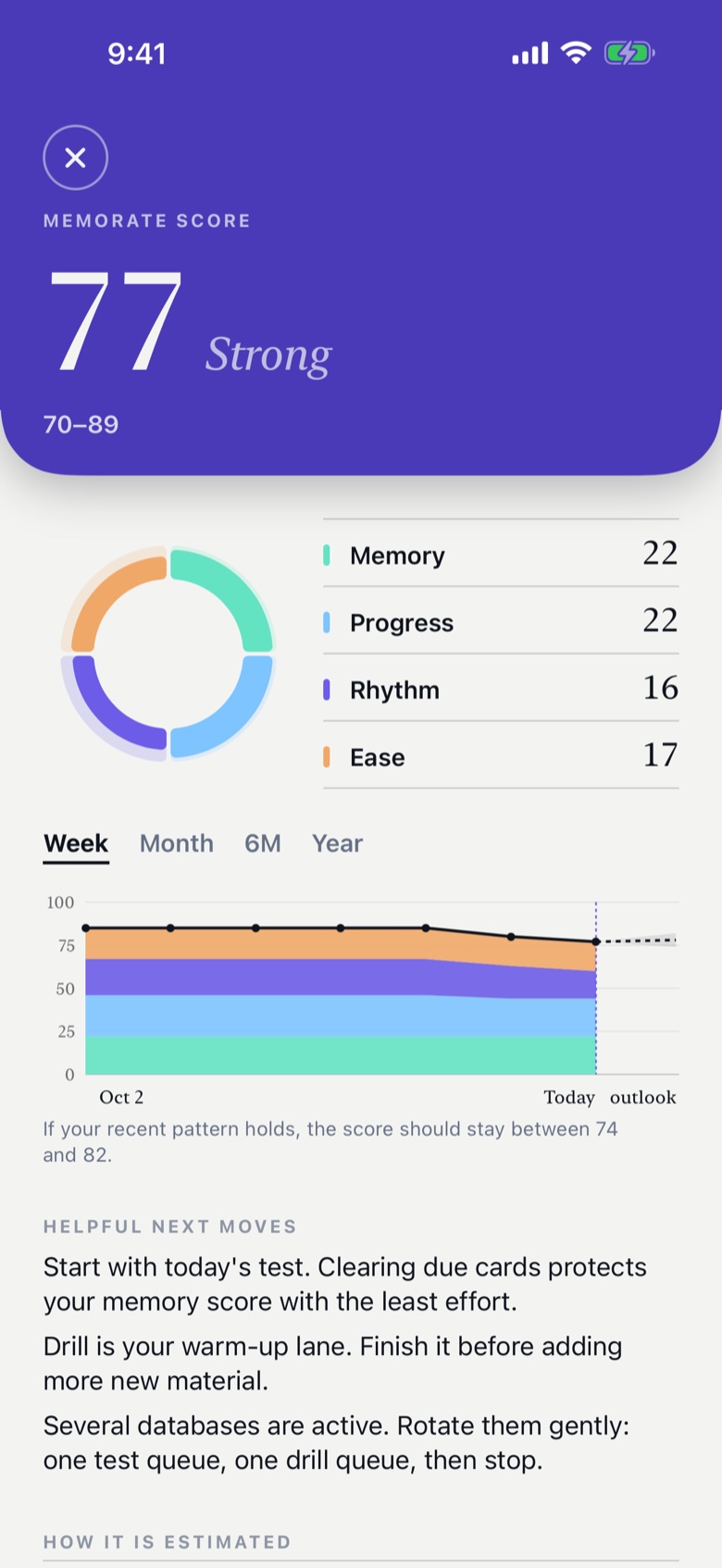
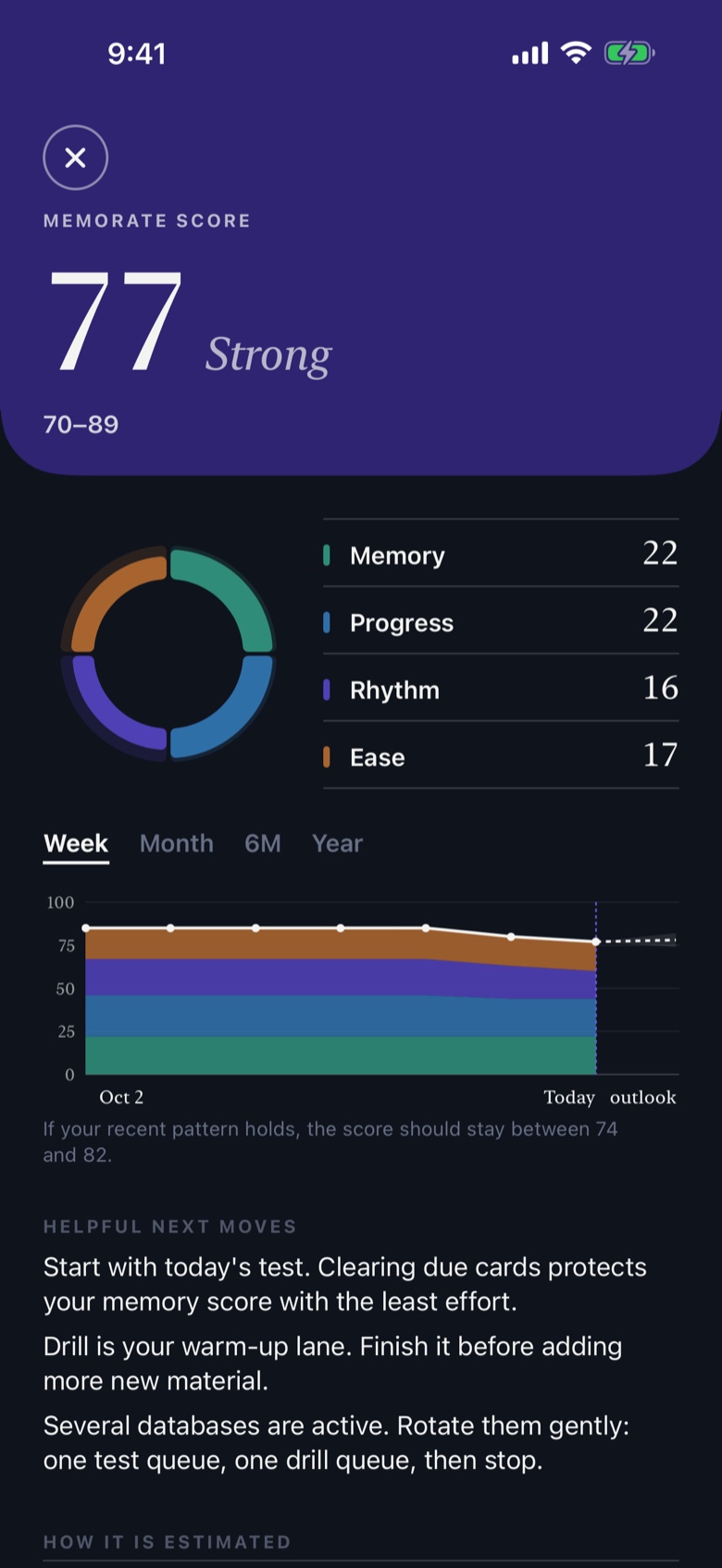
Bands
| Score | Band |
|---|---|
| 0–24 | Starting |
| 25–49 | Building |
| 50–69 | Steady |
| 70–89 | Strong |
| 90–100 | Excellent |
Four components
Each is worth at most 25 points. The even split is deliberate: the score should be readable, not precise.
Memory
How reliably your committed cards should still come back. It rises when you clear due tests and revisit forgotten cards.
Progress
Of the cards you have already tested, how many hold. Cards you have not tested yet do not count against you — taking on new material never lowers this.
Rhythm
How manageable your open test and drill queues feel. Short frequent sessions keep unfinished work from piling up.
Open queues pull Rhythm down only gently. They are useful unfinished work, not failure.
Ease
How demanding the current material feels. It rises when you simplify hard cards and slow down the intake of new ones.
What is in the detail
Tapping the score in the overview opens Score details, top to bottom:
- the band, the points per component and a ring broken down by component, each in its own colour,
- Trend — a chart over a week, a month, six months or a year, with Outlook under it: where the score should stay if your recent pattern holds,
- How it is estimated — every component again, this time with a bar and a sentence on what it measures,
- Helpful next moves — concrete suggestions based on the lowest component.
How to read the ring
Every component has its own quarter of the circle. How much of it you have shows in the thickness of the band: a full band spans the whole width of the ring, half the points make it half as thick, and the pale track around it shows what is still there to gain.
Four components at 25 points each add up to a full 100.
How to read the trend chart
The line with dots is the total score. The dashed line past today is the outlook, and the grey wedge around it is its uncertainty.
The areas under the line are the components, stacked in the same order and the same colours as in the ring. The top of the stack is therefore exactly that line — the components add up to the total, so the chart shows not only how the score moves but what moves it.
When there is no score
No score yet means you have no committed cards. Without them there is nothing to compute.
How to use it
Do not try to push it up by committing more cards. It rises fastest by finishing tests that are already waiting.
When the score drops, look at which component fell:
- Memory down → you are behind on tests and cards come back forgotten,
- Progress down → a lot of cards are falling below C,
- Rhythm down → the queue has piled up, ease off on new material,
- Ease down → the material is too hard; simplify or split your cards.